Tunisia Late Penalties | New Rates & Protection Strategies
Tax & Legal
Nov 30, 2025

While much attention focused on visible tax measures, a silent revolution occurred in the 2023 finance law: the near-systematic doubling of late penalties. Unlike previous years, no tax amnesty measures were included. The message is clear: the Tunisian state wants to be paid on time.
The Game-Changing New Rates (2026 applicable)
Before 2023, late penalties seemed manageable. Today, they're potentially fatal for fragile cash flows:
Delay with voluntary regularization: 1.25% (vs. 0.75% before)
Delay detected by tax audit: 2.25% (vs. 1.25% before)
New fixed fine: 10% of amounts due
VAT and tax fraud: 20% of amounts due
Real-World Example: Actual Impact on Your Cash Flow
Take a business with 100,000 DT in taxes due:
2019 Scenario (old rates)
Voluntary delay: 750 DT
Detected delay: 1,250 DT
2023-2026 Scenario (new rates)
Voluntary delay: 1,250 DT (+67%)
Detected delay: 2,250 DT (+80%)
Plus 10% fixed fine: additional 10,000 DT
The Good News: An Escape Clause Exists
The law provides for a possible reduction if payment occurs within 30 days with debt acknowledgment: the 2.25% rate drops to 1.5%. This narrow but crucial window can save your business thousands of dinars in penalties.
Beyond Declarations: Other Little-Known Offenses
Many businesses are unaware of other violations that can strike at any time:
Failure to clear purchase orders: 2,000 to 5,000 DT per order
Irregular VAT-suspended sales: 50% of tax amounts
Undocumented transfer pricing: 0.5% of transactions (minimum 50,000 DT)
Excessive cash payments: 20% of amount (minimum 1,000 DT)
How to Check Your Status in 2 Minutes
The Ministry of Finance has established a simple SMS service:
Tax status: Send "SF YOUR_TAX_ID" to 85580
Traffic fines: Send "RD YOUR_ID" to 85580
Automatic alerts: Send "AD YOUR_TAX_ID" to 85580
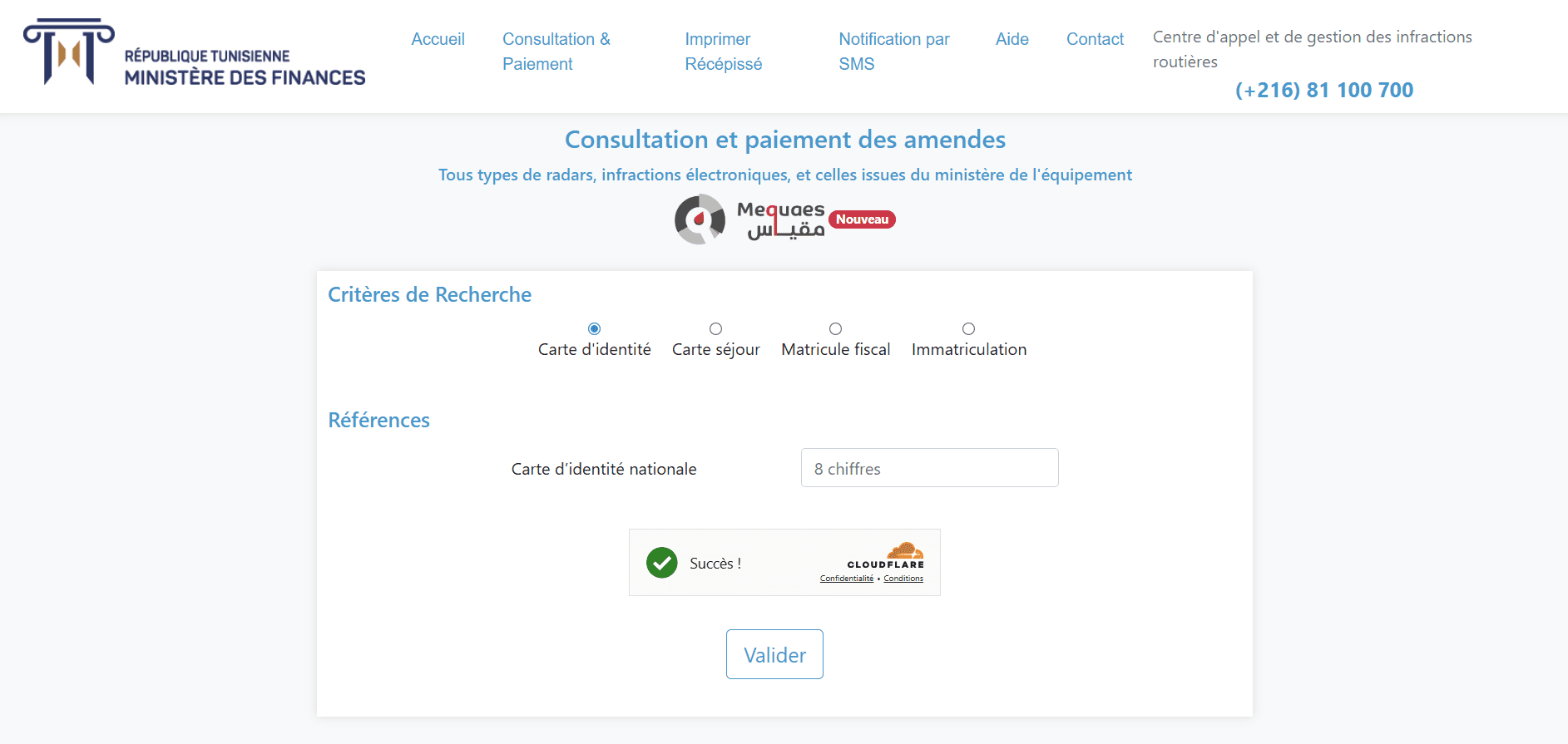
The Tele-Amende Service: Your Unknown Ally
The website amendes.finances.gov.tn allows you to:
Check all your violations in real-time
Prepare fine payments (soon online)
Understand appeal procedures
Access complete legal framework
Protection Strategy: 4 Immediate Actions
Preventive audit: Have your declaration processes verified now
Automated calendar: Never miss another deadline
Continuous training: Your team must know the new rules
Monthly SMS verification: Use the 85580 service every month
Client Testimonial: The Business That Saved 45,000 DT
"We used to treat tax filings as a secondary priority. In January 2023, our new accountant alerted us to the new rates. We conducted a complete audit and discovered 3 late declarations that we immediately regularized. Estimated savings: 45,000 DT in avoided penalties."
The Zero-Tolerance Era Has Arrived
The new penalties transform tax management from a simple administrative obligation into a strategic imperative. In this new context, ignorance is expensive and procrastination becomes a luxury few businesses can afford.
FAQ:
Do the new penalties apply retroactively?
No, only to declarations due from January 1, 2023.
How to contest a penalty?
Through a contentious claim, but success is uncertain. Better to prevent.
Are very small businesses affected?
Absolutely. The new rates apply to all businesses, regardless of size.
Protection Process:
Vulnerability diagnosis
Implementation of automatic alerts
Team training
Quarterly compliance audit
The Legal Foundation: Code des Droits et Procédures Fiscaux
The entire penalty ecosystem is built upon the legal bedrock of the Code des Droits et Procédures Fiscaux (CDPF). This document is not a mere list of rules; it is an algorithmic blueprint. Key articles, particularly those governing majorations (surcharges) and intérêts de retard (late payment interest), function as the source code for penalty calculation. Understanding this code allows an investor to model fiscal risk with a high degree of accuracy.
The Penalty Calculation Algorithm: A Mathematical Model
The Tunisian penalty system operates on a predictable, though often punitive, mathematical model. The base formula for a standard late payment penalty can be expressed as:
P = (D * r * t) + (D)
Where:
P = Total Penalty
D = Due Tax Amount
r = monthly delay rate
t = Time delay in days
This formula demonstrates that penalties are not flat fees but are exponential in nature, scaling directly with the tax due and the time elapsed. For large corporate tax liabilities, even a short delay can result in a significant financial impact, directly eroding ROI.
Know more about our services : Tax Audit Support Tunisia – Professional & Compliant - Luca Pacioli